Notes on getting authentik working
A collection of notes and fixes from setting up authentik as an identity provider with Active Directory LDAP sync, Traefik forward auth, and Docker Swarm. The two main gotchas: AD syncs computer objects as users by default, and group sync fails out of the box with a cryptic “run sync_groups first” error. Below are the fixes and a complete Docker Swarm playground to test it all.
AD sync fixes
set User object filter to exclude computers
(&(objectClass=user)(!(objectClass=computer)))
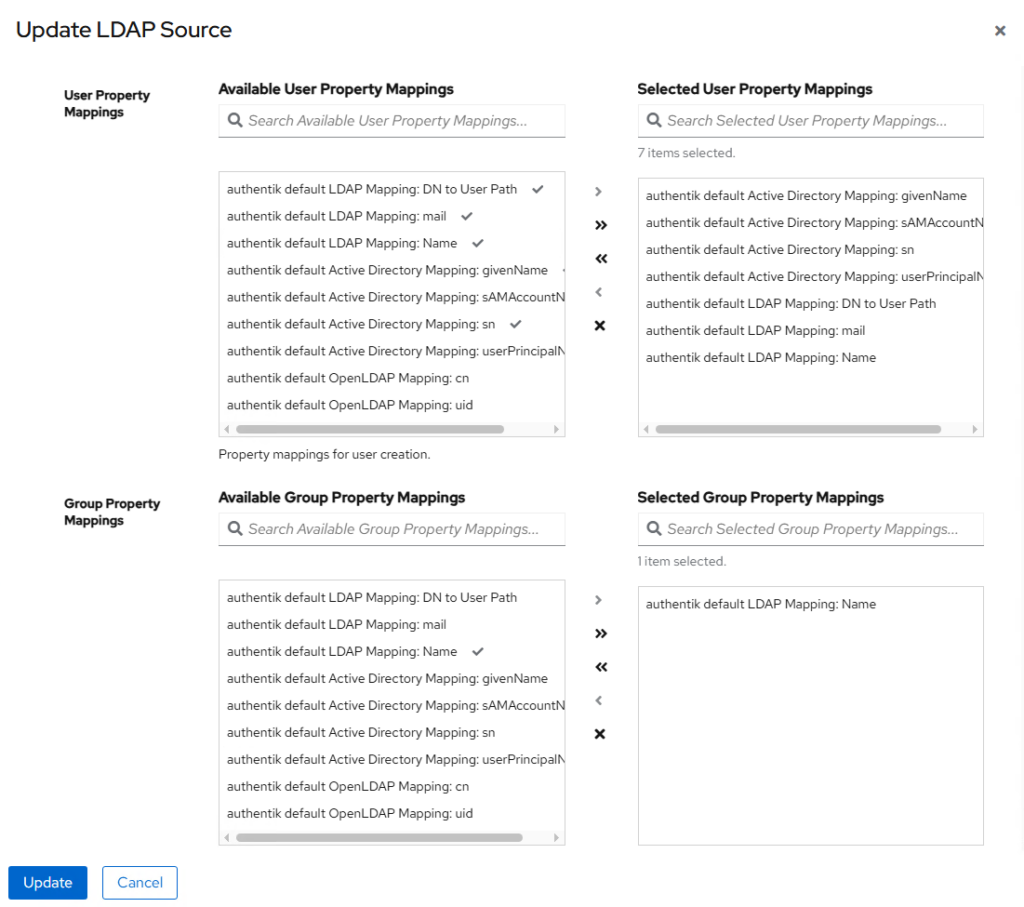
My groups were not syncing — authentik kept erroring with “Group does not exist in our DB yet, run sync_groups first.” This comment on GitHub issue #11427 had the fix: change the group property mapping to use only “authentik default LDAP Mapping: Name” and set the object uniqueness field to “objectSid”.
My swarm demo playground
version: "3.8"

services:
  postgres:
    image: postgres:16-alpine
    environment:
      POSTGRES_DB: authentik
      POSTGRES_USER: authentik
      POSTGRES_PASSWORD: authentik_db_password
    volumes:
      - postgres_data:/var/lib/postgresql/data
    networks:
      - backend
    deploy:
      replicas: 1

  redis:
    image: redis:7-alpine
    command: ["redis-server", "--save", "60", "1", "--loglevel", "warning"]
    volumes:
      - redis_data:/data
    networks:
      - backend
    deploy:
      replicas: 1

  server:
    image: ghcr.io/goauthentik/server:2025.2.1
    command: server
    environment: &authentik-env
      AUTHENTIK_SECRET_KEY: ""
      AUTHENTIK_POSTGRESQL__HOST: postgres
      AUTHENTIK_POSTGRESQL__NAME: authentik
      AUTHENTIK_POSTGRESQL__USER: authentik
      AUTHENTIK_POSTGRESQL__PASSWORD: authentik_db_password
      AUTHENTIK_REDIS__HOST: redis
      AUTHENTIK_BOOTSTRAP_PASSWORD: "admin"
      AUTHENTIK_BOOTSTRAP_TOKEN: "admin-bootstrap-token"
      AUTHENTIK_BOOTSTRAP_EMAIL: "[email protected]"
    networks:
      - proxy
      - backend
    deploy:
      replicas: 1
      labels:
        - "traefik.enable=true"
        # Authentik UI/API
        - "traefik.http.routers.authentik.rule=Host(`auth.localhost`)"
        - "traefik.http.routers.authentik.entrypoints=websecure"
        - "traefik.http.routers.authentik.tls=true"
        - "traefik.http.services.authentik.loadbalancer.server.port=9000"
        # Embedded outpost: handles /outpost.goauthentik.io on app.localhost
        - "traefik.http.routers.authentik-outpost.rule=Host(`app.localhost`) && PathPrefix(`/outpost.goauthentik.io`)"
        - "traefik.http.routers.authentik-outpost.entrypoints=websecure"
        - "traefik.http.routers.authentik-outpost.tls=true"
        - "traefik.http.routers.authentik-outpost.service=authentik"
        # Reusable ForwardAuth middleware (points to embedded outpost on the server)
        - "traefik.http.middlewares.authentik-auth.forwardauth.address=http://authentik_server:9000/outpost.goauthentik.io/auth/traefik"
        - "traefik.http.middlewares.authentik-auth.forwardauth.trustForwardHeader=true"
        - "traefik.http.middlewares.authentik-auth.forwardauth.authResponseHeaders=X-authentik-username,X-authentik-groups,X-authentik-email,X-authentik-name,X-authentik-uid"

  worker:
    image: ghcr.io/goauthentik/server:2025.2.1
    command: worker
    environment: *authentik-env
    networks:
      - backend
    deploy:
      replicas: 1

volumes:
  postgres_data:
  redis_data:

networks:
  proxy:
    external: true
    name: shared_proxy
  backend:
    external: true
    name: shared_backend
My demo app
version: "3.8"

services:
  demo-app:
    image: traefik/whoami:latest
    networks:
      - proxy
    deploy:
      replicas: 1
      labels:
        - "traefik.enable=true"
        - "traefik.http.routers.demo-app.rule=Host(`app.localhost`)"
        - "traefik.http.routers.demo-app.entrypoints=websecure"
        - "traefik.http.routers.demo-app.tls=true"
        - "traefik.http.routers.demo-app.middlewares=authentik-auth@swarm"
        - "traefik.http.services.demo-app.loadbalancer.server.port=80"

networks:
  proxy:
    external: true
    name: shared_proxy
Traefik (Swarm mode – for plain Docker Compose, use providers.docker instead of providers.swarm, move labels from deploy to the service directly, and reference middlewares as @docker instead of @swarm)
version: "3.8"

services:
  traefik:
    image: traefik:v3.6
    command:
      - "--api.dashboard=true"
      - "--api.insecure=true"
      - "--providers.swarm.endpoint=unix:///var/run/docker.sock"
      - "--providers.swarm.exposedByDefault=false"
      - "--providers.swarm.network=shared_proxy"
      - "--providers.file.filename=/etc/traefik/dynamic.yml"
      - "--entrypoints.web.address=:80"
      - "--entrypoints.web.http.redirections.entryPoint.to=websecure"
      - "--entrypoints.web.http.redirections.entryPoint.scheme=https"
      - "--entrypoints.websecure.address=:443"
      - "--log.level=INFO"
    ports:
      - "80:80"
      - "443:443"
      - "8080:8080"
    volumes:
      - /var/run/docker.sock:/var/run/docker.sock:ro
    configs:
      - source: traefik_dynamic
        target: /etc/traefik/dynamic.yml
      - source: tls_cert
        target: /certs/cert.pem
      - source: tls_key
        target: /certs/key.pem
    networks:
      - proxy
    deploy:
      placement:
        constraints:
          - node.role == manager

configs:
  traefik_dynamic:
    file: ./dynamic.yml
  tls_cert:
    file: ./certs/cert.pem
  tls_key:
    file: ./certs/key.pem

networks:
  proxy:
    external: true
    name: shared_proxy
OpenLDAP demo
version: "3.8"

services:
  openldap:
    image: osixia/openldap:1.5.0
    environment:
      LDAP_ORGANISATION: "Demo Corp"
      LDAP_DOMAIN: "demo.local"
      LDAP_BASE_DN: "dc=demo,dc=local"
      LDAP_ADMIN_PASSWORD: "admin_password"
      LDAP_READONLY_USER: "true"
      LDAP_READONLY_USER_USERNAME: "readonly"
      LDAP_READONLY_USER_PASSWORD: "readonly_password"
    volumes:
      - ldap_data:/var/lib/ldap
      - ldap_config:/etc/ldap/slapd.d
    networks:
      default:
        aliases:
          - ldap
    deploy:
      replicas: 1

  ldap-seed:
    image: osixia/openldap:1.5.0
    entrypoint: /bin/bash
    command:
      - -c
      - |
        for i in $$(seq 1 30); do
          ldapsearch -x -H ldap://openldap -D "cn=admin,dc=demo,dc=local" -w admin_password -b "dc=demo,dc=local" > /dev/null 2>&1 && break
          echo "Waiting for LDAP... ($$i/30)"
          sleep 2
        done

        ldapsearch -x -H ldap://openldap -D "cn=admin,dc=demo,dc=local" -w admin_password -b "ou=users,dc=demo,dc=local" > /dev/null 2>&1
        if [ $$? -eq 0 ]; then
          echo "LDAP already seeded, skipping."
          exit 0
        fi

        echo "Seeding LDAP with demo accounts..."

        ldapadd -x -H ldap://openldap -D "cn=admin,dc=demo,dc=local" -w admin_password <<'LDIF'
        dn: ou=users,dc=demo,dc=local
        objectClass: organizationalUnit
        ou: users

        dn: ou=groups,dc=demo,dc=local
        objectClass: organizationalUnit
        ou: groups

        dn: uid=alice,ou=users,dc=demo,dc=local
        objectClass: inetOrgPerson
        objectClass: posixAccount
        objectClass: shadowAccount
        cn: Alice Johnson
        sn: Johnson
        givenName: Alice
        uid: alice
        uidNumber: 1001
        gidNumber: 1001
        mail: [email protected]
        homeDirectory: /home/alice
        userPassword: alice123

        dn: uid=bob,ou=users,dc=demo,dc=local
        objectClass: inetOrgPerson
        objectClass: posixAccount
        objectClass: shadowAccount
        cn: Bob Smith
        sn: Smith
        givenName: Bob
        uid: bob
        uidNumber: 1002
        gidNumber: 1001
        mail: [email protected]
        homeDirectory: /home/bob
        userPassword: bob123

        dn: uid=charlie,ou=users,dc=demo,dc=local
        objectClass: inetOrgPerson
        objectClass: posixAccount
        objectClass: shadowAccount
        cn: Charlie Brown
        sn: Brown
        givenName: Charlie
        uid: charlie
        uidNumber: 1003
        gidNumber: 1001
        mail: [email protected]
        homeDirectory: /home/charlie
        userPassword: charlie123

        dn: cn=developers,ou=groups,dc=demo,dc=local
        objectClass: groupOfNames
        cn: developers
        member: uid=alice,ou=users,dc=demo,dc=local
        member: uid=bob,ou=users,dc=demo,dc=local

        dn: cn=admins,ou=groups,dc=demo,dc=local
        objectClass: groupOfNames
        cn: admins
        member: uid=alice,ou=users,dc=demo,dc=local
        LDIF

        echo "LDAP seeding complete."
    deploy:
      restart_policy:
        condition: on-failure
        max_attempts: 5

volumes:
  ldap_data:
  ldap_config:

networks:
  default:
    external: true
    name: shared_backend
